Brief descriptions of all Susan Leone Grant recipients and projects awarded between 2020-2024
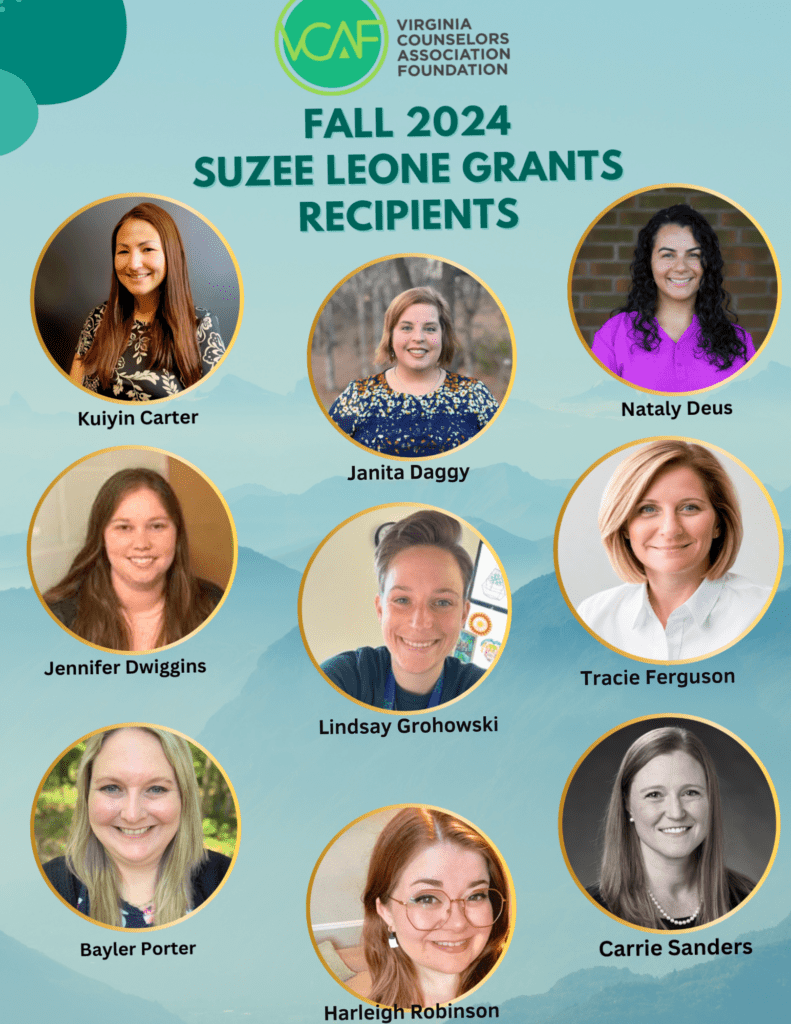
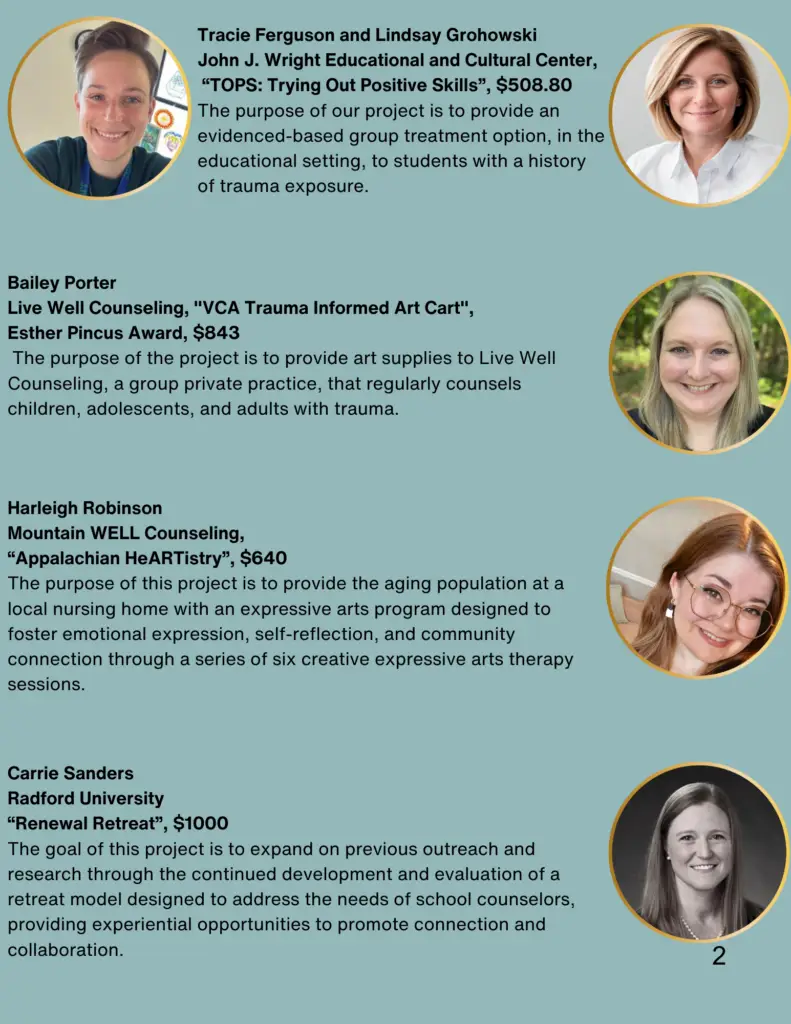
Fall 2024
Spring 2024
The purpose of “Sand Tray Wellness and Education” is to provide Bluefield University Counseling and Wellness Center with sand trays and materials to incorporate tools which would provide emotional well-being and healing to their students that are counseled. This therapy type allows clients to express their feelings nonverbally rather than to articulate them. These sand trays would also help train future counselors in the graduate program. – Bluefield University
The purpose of “Somatic Therapy for Trauma Exposed Inpatient Population” is to provide nervous system regulation to child, adolescent and adult patients as a component of inpatient treatment at Virginia Baptist Hospital. This initiative will introduce regular Somatic Therapy sessions, primarily focused on yoga, tapping and breathwork, tailored to address the needs of patients with trauma-related disorders, including PTSD and adverse childhood experiences. – Centra Health
“Reading for Resiliency” has an overarching goal to expose youth in their early elementary years to a book on socio-emotional skills. Collaborating with Roanoke City Police’s Community Response Bureau, law enforcement officers will go into classrooms to read to our youth. This allows positive relationships to be built between law enforcement and the youth in our community while simultaneously modeling that learning and talking about emotions are healthy and appropriate. – LPC/Roanoke Police Department
The purpose of “Project Gameplan” is to provide social/emotional support for adolescent gamers in the Roanoke area. One goal of “gaming therapy” is to identify gamer strengths that may be applied to presenting issues including social anxiety, feelings of loneliness, and/or interpersonal conflict. Structured like an afterschool program, participants will be welcome to play a variety of games and discuss their real-time gaming experiences while processing real life challenges. – Seeking Wellness
Spring and Fall 2023
Fall 2023
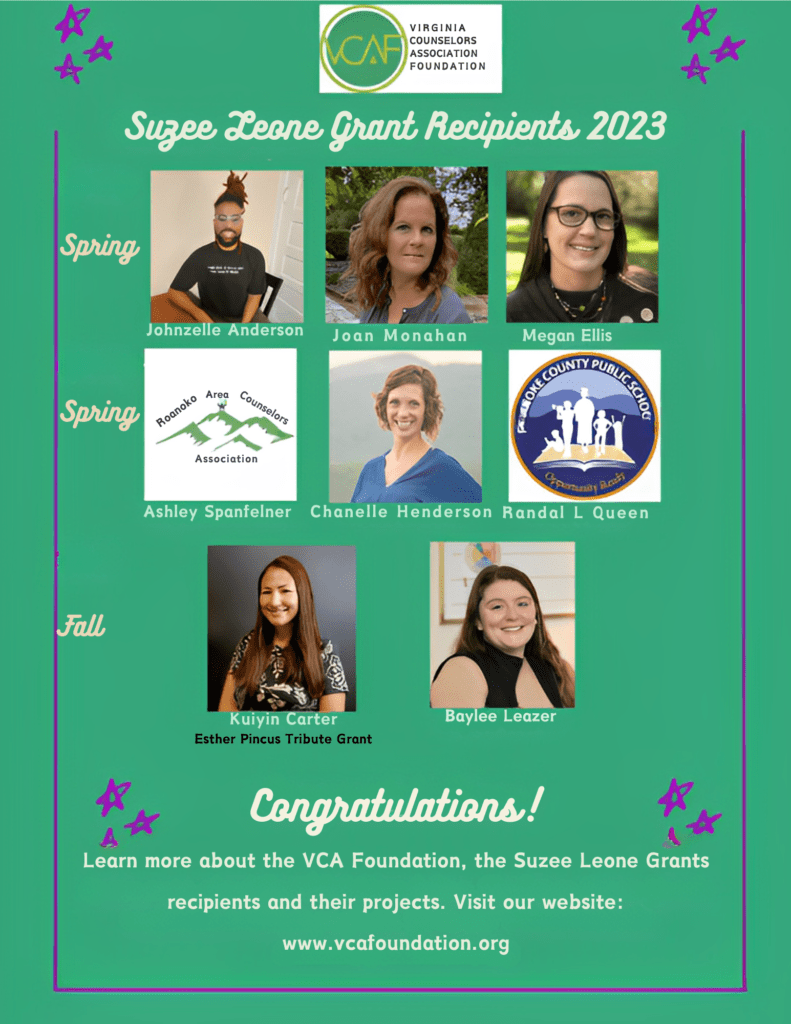
Kuiyin Carter from Pleasants Lane Elementary School: Many students at Pleasants Lane Elementary experience a vast array of trauma and negative life experiences, but are not receiving instruction on positive social skills and coping strategies at home. Because our students are part of a generation with technology at their fingertips, they need more engaging and interesting ways to learn.
The purpose of “Self Regulation for All” is for school counselors to use interesting and engaging games to create more effective small groups aimed at helping our students learn these vital skills. The ultimate goal is for students to learn to self-regulate in times of big emotions, without needing an adult to coach them through it.
This project was also selected as the Esther Pincus Tribute Grant, in memory of our esteemed counselor colleague and high school counselor. The VCA Foundation bestows special recognition on the grant project that affirms the genuine qualities of care and concern extended by Esther Pincus to her family, friends, colleagues and students.
Baylee Leazer from Johnson Health Center: “Resilience Through Movement: Creating Accessible Spaces for Mind/Body Wellness” is a project focusing on providing accessible yoga practice to members of the Lynchburg community with limited resources. This program will teach skills to Johnson Health Center patients related to regulating emotions, becoming more in tune with their body, and reducing physical and emotional pain.
While yoga and meditation are evidence-based practices proven to reduce symptoms of anxiety and other mental health stressors, it is a service that is frequently inaccessible for patients with limited resources due to the cost of classes. With this program, Johnson Health Center would be able to challenge this “wellness desert” by offering no/low cost yoga and mindfulness classes with a trained yoga teacher/resident in counseling.
Spring 2023
Ashley Spanfelner from Roanoke Area Counselors Association: “Having Your Back As You Head Back to School” will show support and boost morale for the school counselors in the Roanoke area by inviting them to participate in a free hour of online continuing education and sending them gift packages that include tools for the counseling trade.
Joan Monahan from Congregational Community Action Project: “Empowerment to Improved Employment” is a program that combines the efforts of the Congregational Community Action Project and Legacy Wellness Center. We will use assessment, education, counseling and coaching to provide clients with the knowledge and resources to work their way out of crisis living.
Megan Ellis from Live Well Counseling and Consulting, LLC: The “Post COVID Library” will be a collection of resources for clinicians to use when providing individual and group counseling to treat anxiety and depression, two mental health challenges that have been on the rise since COVID.
Johnzelle Anderson from Panoramic Counseling, LLC: Additional grant funding was provided to continue “The Mental Health Book Club,” which provides a safe place for participants to reflect on mental health topics in a small group setting, through the medium of literature. Participants learn and grow from engagement in these book discussions, as community and communication are vital components of change and wellness.
Randal I. Queen, School Psychologist from Roanoke County Public Schools: The purpose of the project is to provide an evidenced-based treatment option in an educational setting to students with a history of trauma exposure. Becoming trained in EMDR therapy will create increased opportunities to offer professional help and treatment for our youth.
Chanelle Henderson, LPC and Co-Owner of A Tree Planted Collective: My project includes a two-day collaborative, intensive workshop to provide connection, resources and mental health support to Hispanic mothers in Roanoke. The project idea grew from a need communicated by Hispanic women in a previous support group. The workshop will include topics such as: expectations for Hispanic mothers, preventing children from gang involvement, and coping with anxiety and depression. The overall purpose of the workshop is to build a strong support system in the community.
Fall 2022
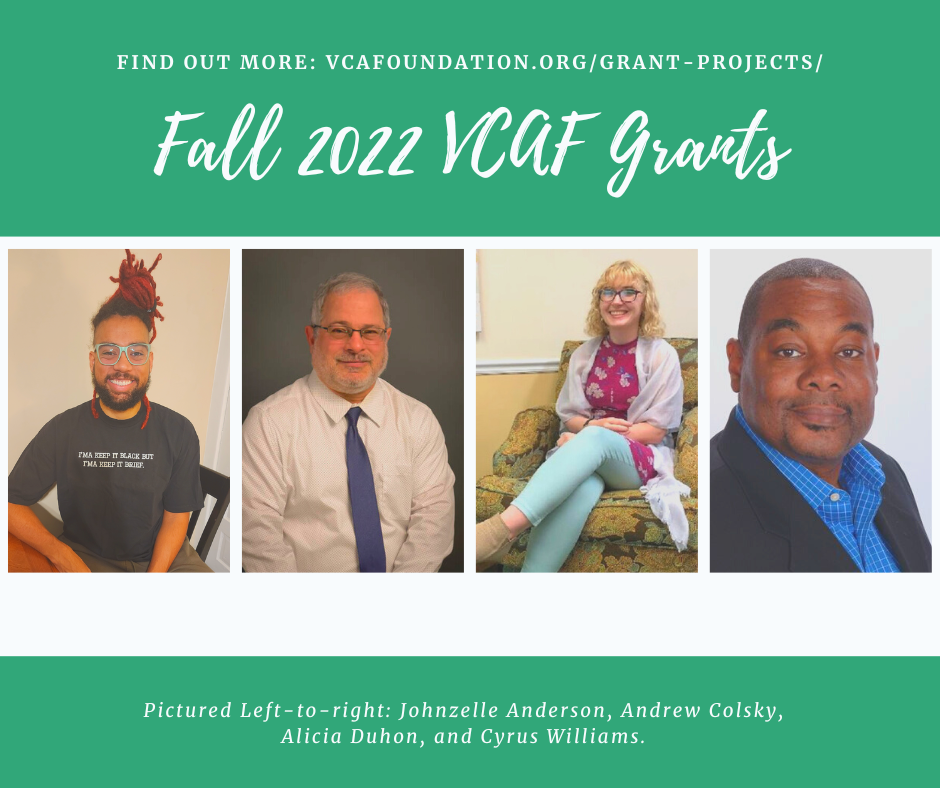
Johnzelle Anderson from Panoramic Counseling, LLC: “The Mental Health Book Club” will provide a safe place for participants to reflect on mental health topics in a small group setting, through the medium of literature. Participants will learn and grow from engagement in these book discussions, as community and communication are vital components of change and wellness.
Cyrus Williams from Impact Counseling, LLC: “Treating Anxiety Using VR” is designed to reduce symptoms of stress and anxiety in children and adolescents ages 12-17. The program incorporates elements of psychoeducation on stress and anxiety, training in mindfulness techniques, and the application of mindfulness based practices using a virtual reality platform and related technology.
Andrew Colsky from Stop My OCD-Fall 2022: Virginia Counseling Association and Stop My OCD are co-sponsoring Virginia’s first “OCD Awareness Campaign.” The campaign is designed to provide OCD awareness to VCA members as well as citizens with OCD and their loved ones. It will consist of a free continuing education course for VCA members, development of a cadre of OCD Awareness Speakers from those trained counselors, a series of OCD Awareness presentations to other counselors and citizens around the state, distribution of awareness materials, creation of an interactive “Ask an OCD Expert” website monitored by an OCD expert and a social media campaign.
Alicia Duhon from Counseling and Forensic Services Inc.: “One More Light: To Help Your Fight with Depression” is a six-week, psycho-educational, strengths-based counseling group, designed for adolescents who are experiencing depression. It incorporates an educational session for parents/guardians that will focus on how to recognize and address depression in teens.
Spring 2022
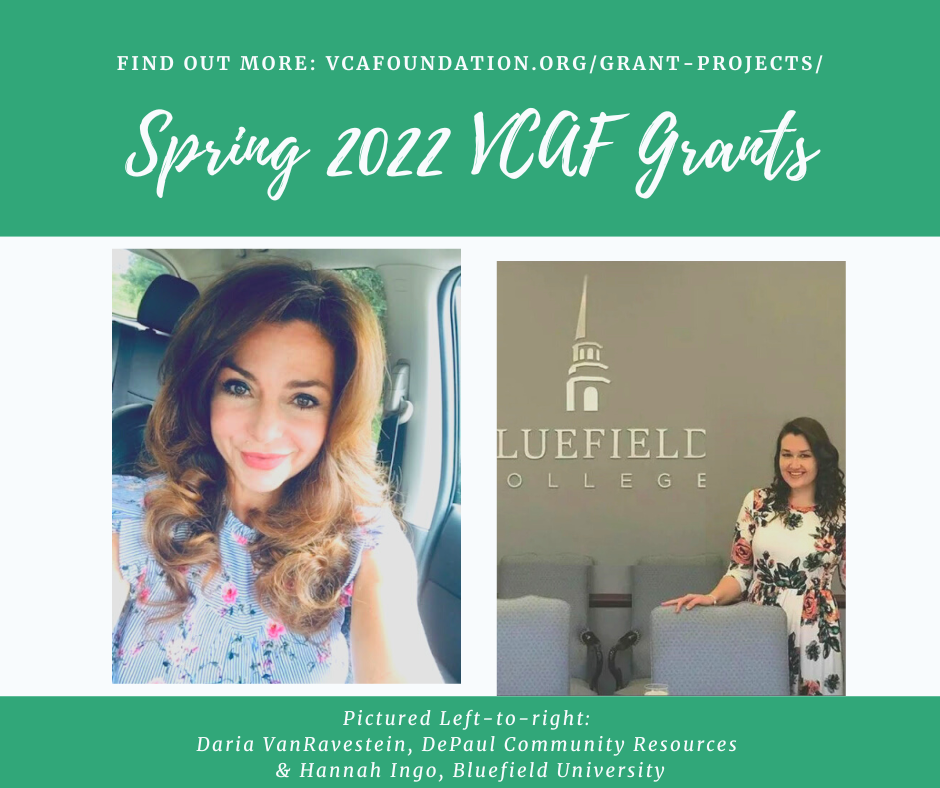
Hannah Ingo, Graduate Assistant, School of Education and Social Sciences, Bluefield University: Bluefield University seeks to expand counseling and wellness services by creating a labyrinth for students. Many students are unfamiliar with what support and wellness look like for them. Bluefield University is aware that they are serving a vulnerable and at-risk population, so the labyrinth is intended to provide a new avenue of wellness for students to explore and uniquely care for their mental health.
The labyrinth on campus would serve as a place for students to stand in the center, breathe and slowly walk back out. This can promote long-term effects such as a newfound calmness, a more profound understanding of oneself, and a deep promotion of “trusting the process.” The labyrinth will open up a new avenue of wellness for all students and encourage them to navigate what support and wellness look like and how healing can come from within themselves. We hope that this project will help students unlock perception, vulnerability and healing.
Daria VanRavestein, DePaul Community Resources, Roanoke wrote the grant, and Amy Burns, LPC is the VCA member on the grant and program manager. DePaul Community Resources received a previous grant from the Virginia Counselors Association Foundation to address the tremendous need for therapeutic services for LGBTQ+ youth in foster care in Virginia by launching the “How to Be You” therapy group to support, empower and create connections for LGBTQ+ youth who are in foster care or have been adopted.
This second round of grant funding allowed DePaul Community Resources to purchase various resources including books, games, supplies and other resources to guide staff and clients into meaningful conversations and discussions.
Fall 2021
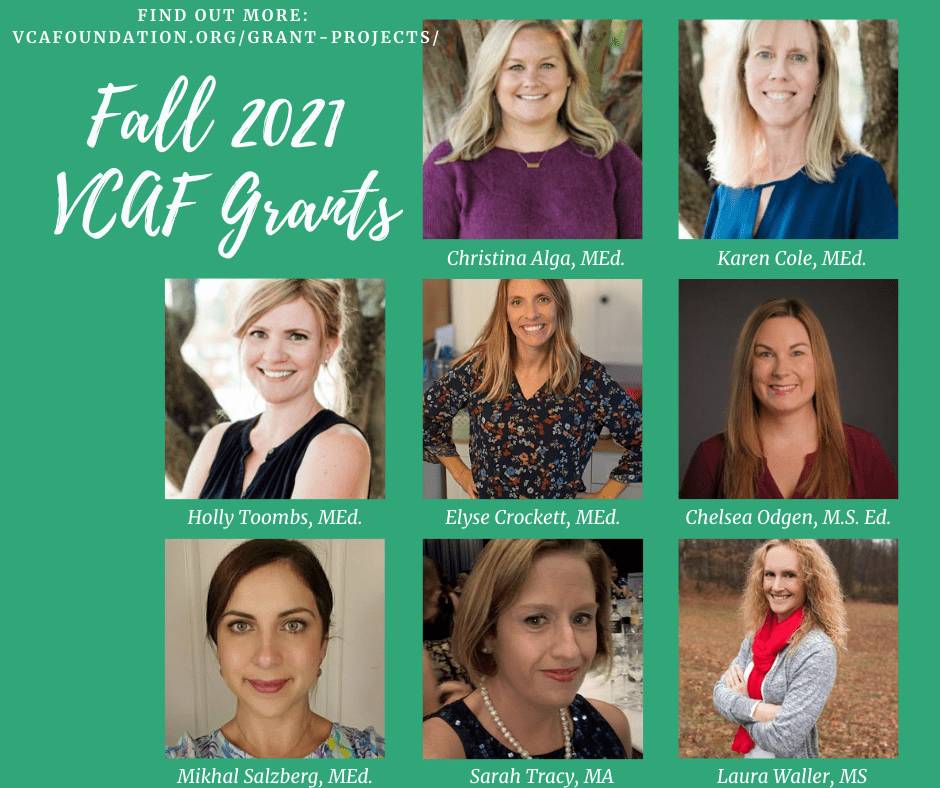
Mikhal Salzberg, School Counselor, Charlottesville: “As if by Magic: An Academic Engagement Group for Middle School Boys” developed for seventh grade boys at Buford Middle School, Charlottesville City Schools. Magic tricks are tricky! They take time and practice. Each week group lessons feature perseverance, leadership and growth mindset tied to learning and performing magic tricks. Through this group, students will have fun, laugh, get frustrated and learn how to work through challenges for a successful outcome.
Elyse Crockett, School Counselor, Hanover County: “Tiger Pause” developed for all John Gandy Elementary School students in grades 3-5, Hanover County Public Schools presented by Elyse Crockett, school counselor. Thirty Tiger Pause spaces will be created in classrooms at John Gandy Elementary School where students will learn to identify feelings, employ coping strategies for uncomfortable emotions and reintegrate into the academic environment. Direct counseling instruction will be delivered to students on feelings identification and coping strategies for uncomfortable emotions.
Chelsea Ogden, Associate Director of Counseling, Johnson Health Center, Lynchburg: “Equipped Counselors, Empowering Children” developed by Chelsea Ogden, associate director of counseling, Johnson Health Center in Lynchburg. The Johnson Health Center will create a robust resource and intervention library which will be used with primarily pediatric clients to include creative interventions and play-based tools.
Sarah Tracy, School Counselor, Prince William County: “Breathe for Change Training – SEL Program” for Rockledge and King Elementary Schools in Prince William County Public Schools presented by Sarah Tracy, school counselor. The project will provide students, staff and the community with lessons in social emotional learning, wellness, yoga, meditation and mindfulness.
Laura Waller, KS Services, LLC, Springfield: “Project CONNECT: Helping families understand the use of Positive Childhood Experiences (PCEs) in order to mitigate the impact of Adverse Childhood Experiences (ACEs)”, created by Laura Waller at KS Services LLC, in Springfield, for teen girls and caregivers. Through Project CONNECT teens and their caregivers will receive support as they transition from virtual to in-person learning. Parents will learn applicable strategies to support students as they return to school. Teens will learn to navigate ACE exposure and implement acts of self-compassion in order to cope with present stressors regarding relationships and expectations.
Christina Alga, Holly Toombs, and Karen Cole, school counselors, Hanover County: “Addressing Anxiety Through Art” developed by Christina Alga, Holly Toombs and Karen Cole, school counselors at Mechanicsville High School in Hanover County Public Schools. This project will incorporate creative activities to help students struggling with mental health concerns such as anxiety and depression. Students will be introduced to art projects such as visual journaling, positive self talk portraits and stress mobiles to help them to identify and express feelings that are difficult to discuss in conversation. They will learn to identify potential triggers in their lives that increase anxiety and be able to recognize the physical effects of stress and anxiety in their bodies.
Spring 2021
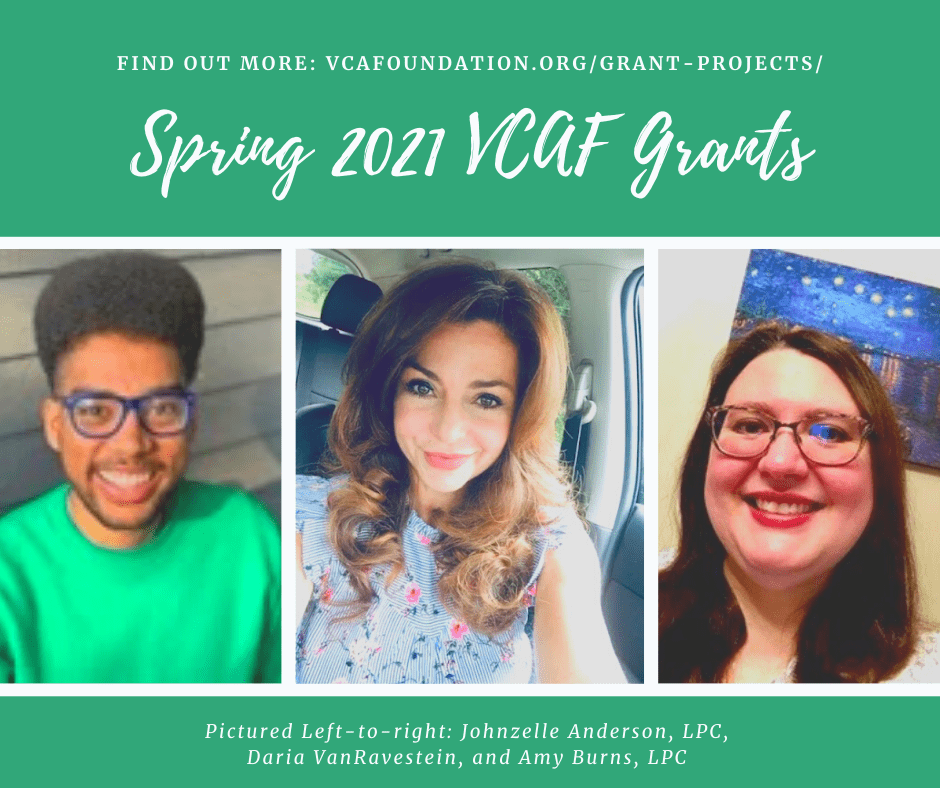
Johnzelle Anderson, LPC, Panorama Counseling, Glen Allen: Anderson’s project, “Perfectly Imperfect: A Podcast on Mental Health for Folx of Color,” received an $800 grant. The purpose of this project is to provide information about mental health issues impacting communities of color and point listeners to resources available, including psychotherapy, primary care and psychiatry.
Daria VanRavestein, DePaul Community Resources, Roanoke wrote the grant, and Amy Burns, LPC is the VCA member on the grant and program manager. The project is “How to Be You: DePaul’s Therapy Group for LGBTQ+ Youth in foster care or adopted. This is a virtual support group, and DePaul Community Resources received $1000 for the grant.
Fall 2020
Megan Ellis, LPC, CSAC, Outpatient Therapist, Live Well Counseling & Consulting, LLC, Roanoke: Received $1000 to provide resources and support for mental health workers to give the life changing tele-health services that are so desperately needed right now. Funding provided will be used to help “Plant Seeds of Hope” for individuals, groups and specifically frontline healthcare workers in need of support during this global coronavirus pandemic.
Briana Gaines, MA, LAC, NCC, Ph.D. Student, JMU, THRIVE Coordinator, Harrisonburg: Received $400 to provide a one-year outreach project focused on race-based trauma in three counties and one city. Lack of training in this area perpetuates the cycle of inadequate preparation, suggesting that racial disparities in access to treatment and quality of treatment are likely to continue. It is imperative that counselor educators and the counseling profession create evidence-based methods for identifying and addressing race-based trauma. Leveraging relationships with the CACREP accredited counseling programs at James Madison University, this program intends to create evidence-based methods for identifying and addressing race-based trauma in clinical and classroom settings. This project intends to disseminate a racial climate needs assessment; develop a race-based trauma treatment model based on data regarding the provision of counseling services to POC; and facilitate a race-based trauma symposium for counselors to enhance the delivery of race- based trauma services for rural and medically underserved POC.
Aiesha Lee, Doctoral Student W&M, Williamsburg: Received $350 for The Melanin Scholars Retreat, mentoring Black women in research. The retreat aims to support BW faculty and doctoral students in Counselor Education and cultivate their writing and research initiatives. Participation in a writing retreat may help to mitigate some of the barriers for BW students and faculty. In addition, understanding the experiences of those participating in the retreat is critical in expanding what we currently know about writing support groups for BW in the academy. Consequently, in this study, the researchers will use an autoethnographic self-collaboration study to address the following research questions: What are the collaborative experiences of BW who participate in the Melanin Scholars Retreat and how do these experiences influence the participants’ professional journeys? The full retreat will take place during the summer of 2021, however the pilot phase will encompass a two-day virtual event in January 2021. During the pilot phase participants will engage in a structured writing retreat with checkpoints in the morning, early afternoon, and a wrap-up at the end of the day. With this structure, the participants will be given a timeline to work through and prompts to support their writing goals. At the end of the two-day event, participants will provide formative feedback to the researchers which will enhance the structure for the full writing retreat scheduled to follow in the summer.
Nathaniel Mason, M.Ed., NCC, Ph.D. student W&M: Received $400 for a program located in Hampton Roads. Grant funds will be used to start a new project to address the unique needs of LGBTQ+ young adults struggling with the effects of minority stressors, including loneliness and isolation that has been compounded since COVID. The six-week group will include an introduction to the benefits of social connectedness as well as therapeutically-appropriate ice breakers to build group cohesion and trust. The following weeks will include empirically-supported interventions including processing the role of minority stressors, the use of CBT in facilitating connectedness and reaching out to others, mindfulness as a way to gauge current feelings, practicing new skills learned outside of session, and a final group session for summarizing what was learned. The project will then transition into the data analysis phase which will likely include interviews from participants and quantitative evaluation summaries to support what went well in the group as well as considerations for future groups. These findings will then be disseminated to local clinicians in presentation and publication format. These findings and recommendations will contribute to the continued professional development of Virginia clinicians to increase their competence and sense of self-efficacy in working with LGBTQ+ adults in light of the current pandemic.
Dr. Shekila Melchior, Assistant Professor, GMU, Fairfax, the Fourth Annual Esther Pincus Grantee: Received $500 to expand on an existing project with a group called The Amigas. The original project explored the social and living conditions of undocumented Central American immigrant mothers and their families during the COVID-19 pandemic. A gap emerged in the findings of the study, the experiences of their school-aged children. As a result, the researchers seek to expand on that existing project and address the needs of the children in the home. More specifically, their transition to online learning and their perspectives on the impact COVID-19 has had on them and their family as well as how it could potentially impact their future. As a result, a Youth Community Advisory Board committee will be formed to give voice to the students directly experiencing these barriers and to provide knowledge and strategies to the community and schools that serve them.
Charity Thompson, Clinical Director of Outpatient Services, Trinity Care, LLC, North Chesterfield: Received $850 for the Harvesting ROSES (Resilient Opportunities for Social & Emotional Support) program dedicated to supporting the social and emotional growth and development of adolescents ages 12-17 years old. During adolescence, children face many challenges, including physiological changes that can interfere with daily functioning. While adolescents will experience normal changes during this period, we strive to support the changes that adolescents struggle to understand or manage. The program seeks to enhance social and emotional well-being that will positively improve daily functioning. The goal of the Harvesting ROSES program is to provide counseling and support in the areas of social and emotional well-being. With supporting adolescents’ social and emotional development, the program strives to ultimately create positive change and improvement in all areas of life.
Spring 2020
Dr. Christa A. Benton, LPC, NCC-Counselor, Anna Julia Cooper Episcopal School, a faith-based school serving, tuition free, 4th-8th grade students of limited economic resources. Many students have been exposed to unfortunate events and hardship placing them at risk for engaging in disruptive and distractive behaviors having limited self-regulation skills to cope with external and internal triggers and unresolved trauma they have experienced. In an effort to provide the students a safe, positive and successful school learning environment, a social-emotional mental health program was established to support them with combating the challenges that impede their academic and social growth. A $1000 grant was awarded to supplement and enhance the 2020-21 school year curriculum for the weekly social-emotional development group that all enrolled students participate in during the school day. Grant funds will be used to enhance the curriculum by providing experiences to enhance their learning of life skills, social skills and independent coping skills. The project also expects to enhance the learning environment for teachers and students by increasing both academic and behavioral successes across content areas.
Megan A. Ellis, LPC, CSAC, Outpatient Therapist, Thriving Families Counseling Center
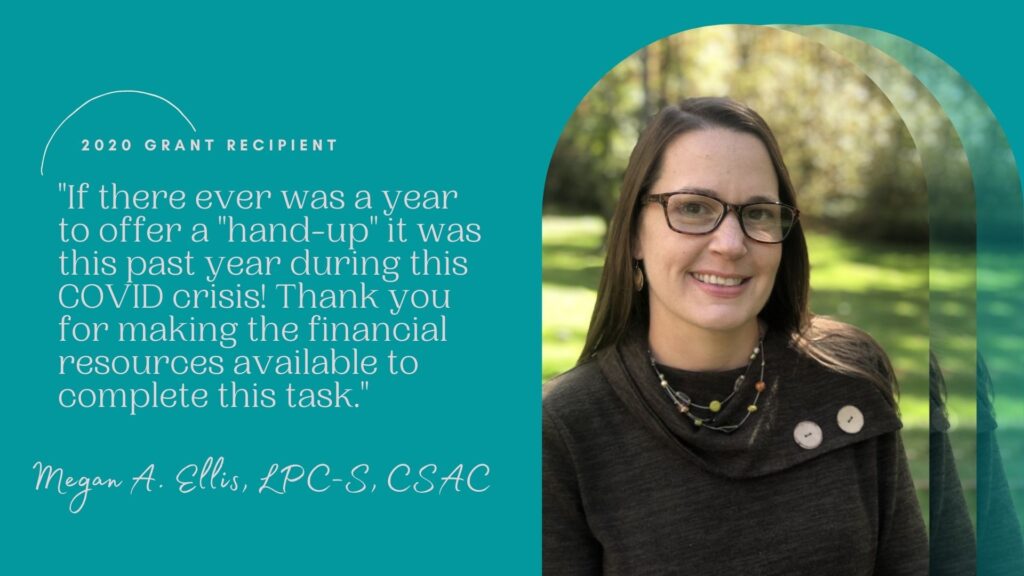
Received $1000 to address the need for basic, hands-on tools for students in the foster care system to use to help cope with the anxiety they often suffer with in silence. The project will also look at the impact basic stress reduction tools can have on the overall mental health and well-being of this underserved population. Most importantly, this project intends to provide lifelong tools for this traumatized population to use when anxiety and stress inevitably arise throughout their lifespan. A secondary goal is to introduce resident counseling staff to ongoing relaxation and mindfulness opportunities to help them prevent counselor burnout, improve counselor efficacy and provide tools to create a more balanced and mentally healthy workplace that can in turn create better treatment outcomes for the populations they serve.
Marisa Jones, M.Ed., School Counseling Student, Linkhorne Middle School and University of Lynchburg
Received a $500 grant to establish the ReSet Room to provide a supportive therapeutic environment to assist students with self-calming and emotional regulation through an environment that promotes relaxation. It is a designated safe place to settle down when things become overwhelming and upsetting through calming visual, auditory and tactile stimuli.
Short term goals are to reduce in-class incidents, decrease number of students wandering the hallways, in the office and skill building for long-term emotional regulation through mindfulness and de-stressing activities.
Long-term outcomes are to decrease referrals, therefore decrease in-school suspensions, leading to a decrease in out-of-school suspensions related to behavior. Students will learn skills to benefit their well-being, self-awareness, resiliency and self-care. This will encourage growth within the community, beyond the school, giving students skills to succeed in life.
Autumn Randell, M.A., NCC, Resident in Counseling (LPC-R), Ph.D. Candidate, VCU School of Education & Graduate Assistant, VCU College of Engineering Career Center
Received $400 to examine school counselors’ perspectives surrounding the role they play in supporting underrepresented high school students who are interested in STEM careers. The short-term outcome of this study is to collect more information and give voice to school counselors’ perspectives on how they support underrepresented students’ pursuit of STEM careers. Long-term outcomes include disseminating the results of this study to Virginia School Counselors and Counselor Educators through VCA and VACES conferences, adding to the literature on the role and impact of school counselors by submitting a manuscript for publication in counseling journals, and using the results of this project to advocate for school counselors as key stakeholders in underrepresented students’ career development and choice, especially in regard to STEM Careers. As a result of participating in this study, participants will be helping to bridge a gap in the school counseling literature and bring light to the important work that school counselors do for marginalized students.
Charles Shepard, LPC, NCC, Clinical Director, Couple & Family Counselor, The ARROW Project. Received $600 for a project for audio-visual equipment to provide supervision for residents in counseling that extends the standard of supervision set by CACREP for graduate counseling programs. This will be accomplished by providing Video-Review (VR) supervision to at least five residents in counseling providing services through The ARROW Project clinic and community-based programs. Anticipated short-term outcomes are that the Staunton, Augusta and Waynesboro (SAW) Region will have more mental health providers, residents in counseling will have improved comfort with the VR supervision format, and will gain a deeper level of self-and professional-awareness as a result of the VR supervision format. Long-term goals are that the area will have more licensed mental health care providers and more clinical supervisors who are likely to use VR supervision.